Showing posts with label Latin America. Show all posts

Wednesday, February 20, 2008

Cuba - Tales of another Occupation

A year ago I began what I hoped would have been an historical series on twentieth century relations between Cuba and the United States, following the Spanish American War. After two installments, I was unable to keep up with it. Although I haven't abandoned the idea altogether, the historic decision of Fidel Castro not to run for re-election as President of the State Council has motivated me to re-post what I had written back then.

PART I


The 24th of February will mark 51 years since the New York Times correspondent and editor Herbert L. Matthews (no relation to me) published his first in a series of articles on Fidel Castro, marking the 26 of July Movement's first steps out of the Sierra Maestra mountains and toward its eventual ascendency to power in Cuba. Criticized as partial to Fidel Castro, Matthews nevertheless spoke words that would prove prophetic and resonate throughout Latin America:


One might say Fidel Castro was like Pandora. The box was there and all the troubles were in it – and he opened the box. Latin America is moving fast, and not necessarily with us or toward us. The social and economic pressures have revolutionary possibilities. Our policies to date have not been successful. They have been too negative, too little, too closely tied to dictators and to small ruling classes who will become victims of the new social pressures if they do not move quickly and make necessary reforms. Stability and the status quo are dreams of the past. We have lost the Cuba we knew and dominated, or influenced so greatly. Our relations with Cuba will never be the same , even when they become friendly again, as they must. (Herbert L. Matthews, The Cuban Story, New York: Braziller, 1961, p. 273)

The United States is going to continue to have a difficult time dealing with Fidel Castro’s legacy, even after his passing. It is no secret that the US had actively sought to depose and even eliminate the Cuban leader in order to replace the island’s communist government with one favorable to US interests. Instead of passing judgement on Castro’s years in power as supreme leader of Cuba, I would instead like to go back in history to examine to some degree why someone like Castro came to power in the first place. I do it in the hopes of contributing to the examination of the roots of animosity and outright rebelliousness of not a few Latin American administrations towards the US government and its policies (notice that I am - purposely - not using the phrase “roots of anti-Americanism”). As author Thomas G. Paterson writes in the first chapter of his 1994 book Contesting Castro: The United States and the Triumph of the Cuban Revolution, in the mid nineteen fifties:


Castro had no ties with Cuba's Communist Party – at least not at this time. His dissident organization actually distrusted the Communists because of their onetime sordid alliance with Fulgencio Batista, the very dictator the rebels intended to topple. Castro's most conspicuous model in the mid-1950's was the hero of the 1890's Cuban Revolution José Martí, not Karl Marx, V.I. Lenin, Mao Zedong or Josef Stalin. (pages 15-16).

So what happened? Historians have long debated whether Castro, once in power, was pushed by the Eisenhower administration into the arms of the communists, or if he had come to power with the intent of converting the island to communism all along. That debate is not as interesting as why there may have existed in Cuba (and, for that matter, elsewhere in Latin America) a widespread distrust of and even antagonism towards the United States government in the first place. In fact, I believe the debate about Fidel’s intentions was largely settled by Allen Luxenberg in his 1988 articleDid Eisenhower Push Castro into the Arms of the Soviets”, (Journal of Inter-American Studies and World Affairs, Vol. 30, No. 1 pages 37-72.)


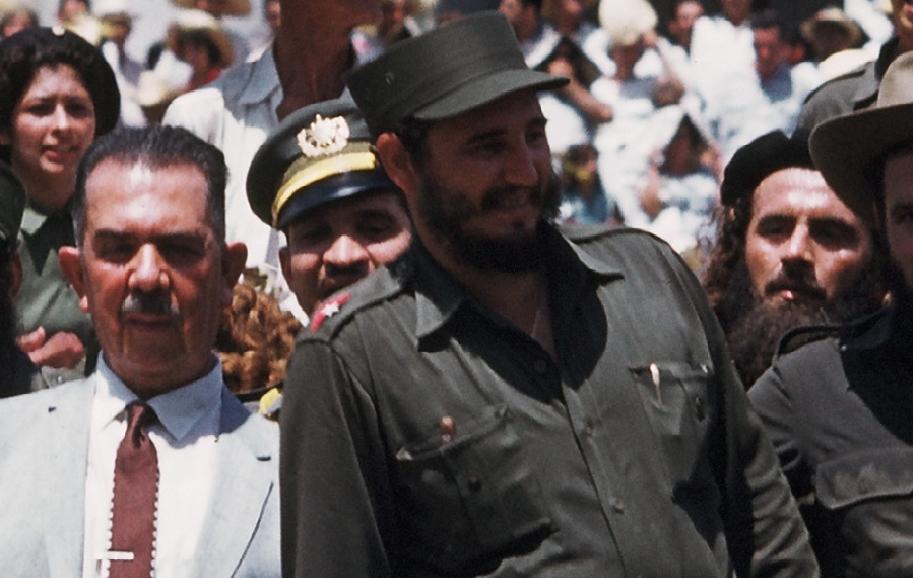
(The photo of l to r Cuautémoc & Lázaro Cárdenas, Fidel Castro & his son was taken by my father, Dr. Thomas G. Mathews)


It is evident that when Castro came to power, his seemingly abrupt repudiation of the United States came as a shock to many ordinary Americans. As Louis A. Perez Jr. expressed in “Fear and Loathing of Fidel Castro: Sources of US Policy toward Cuba”,


North Americans viewed early developments in Cuba with a mixture of incomprehension and incredulity. Much had to do with the pace of events: everything moved so quickly, as events with portentous implications seemed to accelerate from one day to the next in vertiginous succession. There was no frame of reference with which to take measure of developments in Cuba: no precedent, no counterpart, but most of all there was no understanding of the larger historical circumstances from which the Cuban revolution had emerged. (Journal of Latin American Studies, Vol. 34, Part 2, May 2002, page 229)

It is precisely these historical circumstances that must be reviewed to understand why someone like Castro could emerge as a leader of a Latin American country. Cuba’s hostility toward the United States can be attributed in part to U.S. policies toward the island since 1898. That was the year of what North Americans have dubbed the Spanish American War.

(note: I am at great pains to recommend a single book as the definitive account of the “Spanish American War”, since there are many writings on the subject as well as diverse interpretations of the events; nevertheless, I am advised that David Trasks’ book is among the best one might find in a single volume).

Herein lays one of the main roots of the historic US-Cuban discord. Cubans have resented the US depiction of the war as primarily a battle between Spain and the United States. As Lars Schoultz expounds in his commentary Blessings of Liberty: The United States and the Promotion of Democracy in Cuba:


The Cuban contribution had been considerable: after three years of warfare the rebels had pinned down nearly all of the 200,000 Spanish troops on the island, and that alone explains why Cubans have always been upset by the term US citizens use for the conflict – the Spanish American War – which overlooks their role in the proceedings. (Journal of Latin American Studies, Vol. 34, Part 2, May 2002, page 399)

One of the great heroes of what Cubans prefer to call the Spanish-Cuban-American War was General Antonio Maceo Grajales, a black man who was popularly known as the Titan of Bronze. Described as one of the outstanding guerrilla leaders in nineteenth century Latin America, Maceo’s


...most famous campaign in the War of Cuban liberation was his invasion of western Cuba when his troops, mostly Afro-Cubans on horseback, covered more than 1,000 miles in 92 days and fought the enemy in 27 separate encounters.

Noted historian Ada Ferrer points out that the presence of blacks among Cuban revolutionaries brought anti-racism to the fore in the struggle for independence. (See also the historical references to the Mambises) The experiences of these black insurgents became fundamental to the unfolding of the new republic and held out the promise of the eventual establishment of a color-blind nation. While Spain was defeated in the war, what took place in its aftermath clearly dismayed the brave Cuban fighters. As Lars Schoultz explains,


No Cuban helped to negotiate the armistice signed by Spain and the United States in Washington in August; it required the Spanish to relinquish sovereignty over Cuba pending negotiation of a treaty of peace, which was signed in Paris in December, again without Cuban participation. It declared that Cuba ‘is, upon evacuation by Spain, to be occupied by the United States’. (page 399)

And this in the face of a US Congressional War Resolution known as the Teller Amendment that explicitly stated that the US would not annex Cuba. It is important to note that while the United States supposedly joined the war to assist the Cubans in liberating their country from the yoke of the Spanish, the tables were now turned and Cuba had actually become a war booty with the US presence emanating from the “right of conquest” instead of any invitation or formal understanding with Cuban leaders. General John R. Brooke, to who the Spanish formally turned over the Cuban capital in 1899 (and who became the first US military commander of the island) exemplified the condescending and paternalistic approach which would characterize the US occupation of the island. According to Lester D. Langley:


Having condemned Spain for its backward colonialism, Brooke... accepted the Spanish characterization of Cubans as people incapable of self-rule who required enlightened guidance. (...) In assuming power, Brooke retained much of the Spanish administrative structure, modifying it to meet the current requirements; he even kept a number of Spanish bureaucrats. (The United States and the Caribbean in the Twentieth Century, Fourth Ed., U. of Georgia Press, 1989: pages 18-19)

Meanwhile, in the eastern part of the island, the eventual successor to Brooke was already stamping his imprimatur on the American occupation by implementing a


regimen which included, among other punishments, public whippings for those who violated his civic code. (Langley, page 19)

This individual was General Leonard Wood, who would become a particularly notorious irritant to the Cubans. Leonard Wood (who would later go on to notoriety as the butcher of Muslims in the Phillipines) was one of a group of likeminded government functionaries, that included such “luminaries” as US President McKinley’s Secretaries of War, Elihu Root, and State, John Hay, that disliked the Teller Amendment and clearly favored annexing Cuba to the United States. Lars Schoultz documents the racist nature of the US occupation under Leonard Wood:


But the Cubans could not be convinced so quickly to become part of the United States, and so Governor-General Wood tried to extend the transition period. ‘We are going ahead as fast as we can,’ he wrote the president in 1900, ‘but we are dealing with a race that has steadily been going down for a hundred years into which we have got to infuse new life, new principles and new methods of doing things. This is not the work of a day or of a year, but of a longer period.’ (...) ...the president ordered Wood to accelerate the transition. The first task was to disenfranchise that part of the Cuban population which had gone furthest downhill. By decree Wood restricted suffrage to Cuban born males over the age of twenty who could meet one of three requirements: the ability to read and write, the possession of property valued at $250 or more, or military service in the insurgent forces. This eliminated two thirds of Cuba’s males over the age of twenty, and ...Elihu Root congratulated his general when he learned that ‘whites so greatly outnumbered blacks’ in the truncated electorate. (pages 400 – 401)

PART II (originally posted on March 11, 2007)


Following some brief notes about the current Cuban transition to a new leadership, we go back in time to examine the infamous Platt Amendment, which compounded the already deteriorating relations between the island and its North American occupier following the war.


(The above photo is of the Havana waterfront taken during my 1979 visit)

Speculation abounds in the press of the United States regarding the possible fate(s) of Cuba following Fidel Castro’s decision to step down due to illness. Although he appears to be making a slow but steady recovery, it is evident he will no longer be able to hold the island’s foremost leadership position. What seems to have escaped the US media in its unbound enthusiasm for a radical change in the political direction of the country is the fact, apparent to anyone who cares to analyze the situation seriously, that an orderly transition to a new leadership under the aegis of the Communist Party has already taken place.

People in the know like Nelson and David Rockefeller Senior Fellow and Director of Latin American Studies at the Council on Foreign Relations, Julia E. Sweig (who not only has publications about Cuba but has traveled to the island some 30 times over the past 23 years, meeting with a wide spectrum of people from Fidel Castro to his regime’s political prisoners) are aware that despite not being a US style Jeffersonian democracy, Cuba:


... is a functioning country with highly opinionated citizens where locally elected officials (albeit all from one party) worry about issues such as garbage collection, public transportation, employment, education, health care, and safety. Although plagued by worsening corruption, Cuban institutions are staffed by an educated civil service, battle-tested military officers, a capable diplomatic corps, and a skilled work force. Cuban citizens are highly literate, cosmopolitan, endlessly entrepreneurial, and by global standards quite healthy.

This panorama is seldom acknowledged by the Cuban government’s (exiled) detractors, which at times seem to have an all-too-privileged access to the halls of power in the United States. People without such blinders would readily acknowledge what Sweig has concluded: that the Cuban government has garnered sufficient legitimacy over the years to undertake a smooth leadership transition:


People at all levels of the Cuban government and the Communist Party were enormously confident of the regime's ability to survive Fidel's passing. In and out of government circles, critics and supporters alike -- including in the state-run press -- readily acknowledge major problems with productivity and the delivery of goods and services. But the regime's still-viable entitlement programs and a widespread sense that Raúl is the right man to confront corruption and bring accountable governance give the current leadership more legitimacy than it could possibly derive from repression alone (the usual explanation foreigners give for the regime's staying power).

This should get some people thinking. The Cuban leadership has maintained itself defiant towards the US throughout its nearly 50 year history. If it is still in power and enjoys such a level of legitimacy as to be able to guarantee continuity of the Revolution via a smooth transition to a new leadership, maybe there is something to all the anti US government rhetoric (please notice, again, that I am using the phrase anti US government , instead of anti US). As Sweig again acknowledges:


In Cuba's national narrative, outside powers -- whether Spain in the nineteenth century or the United States in the twentieth -- have preyed on Cuba's internal division to dominate Cuban politics. Revolutionary ideology emphasizes this history of thwarted independence and imperialist meddling, from the Spanish-American War to the Bay of Pigs, to sustain a national consensus. Unity at home, the message goes, is the best defense against the only external power Cuba still regards as a threat -- the United States.


THE PLATT AMENDMENT
On November 5, 1900, Governor-General Leonard Wood (who, as noted in PART I, would rise to further notoriety in the Philippines) called for a constitutional convention in Cuba’s capital. However, just four months later the Cuban constitutional convention was given a set of articles which had originated as a US legislative amendment to the Army Appropriation Act of 1901, sponsored by Senator Orville Platt of Connecticut. What became known as the Platt Amendment reflected US President McKinley’s Secretary of War, Elihu Root’s and General Wood’s (both annexationists) prescriptions for future Cuban-US relations. It placed onerous restrictions on Cuban sovereignty and was immediately rejected by the constituent assembly as well as sectors of the Cuban population. Two provisions of the amendment are of particular importance:


Article III. The Government of Cuba consents that the United States may exercise the right to intervene for the preservation of Cuban independence, the maintenance of a government adequate for the protection of life, property, and individual liberty, and for discharging the obligations with respect to Cuba imposed by the Treaty of Paris on the United States, now to be assumed and undertaken by the Government of Cuba. Article VII. To enable the United States to maintain the independence of Cuba, and to protect the people thereof, as well as for its own defense, the Cuban Government will sell or lease to the United States the land necessary for coaling or naval stations, at certain specified points, to be agreed upon with the President of the United States. (As reproduced in: Leo Huberman & Paul M. Sweezy, Cuba: Anatomy of a Revolution, Monthly Review Press, New York, 1960: page 15)

As Lars Schoultz explains:


Once McKinley had signed the Platt Amendment into law, ...Root informed the Cubans that they were obliged to append it to their new constitution. When the constituent assembly refused by a vote of 24 to 2, he instructed Wood to tell the Cubans that the US occupation would continue indefinitely ‘if they continue to exhibit ingratitude and entire lack of appreciation of the expenditure of blood and treasure of the United States to secure their freedom from Spain’. [Elihu Root papers cited by Schoultz] With no alternative but capitulation, the constituent assembly grudgingly added the Amendment’s eight articles to their constitution; in return, Governor General Wood presided over Cuba’s first transition to Democracy, then sailed for home. Shortly before leaving he wrote to assure his new President, Theodore Roosevelt, that ‘there is, of course, little or no independence left Cuba under the Platt Amendment’. (Blessings of Liberty: The United States and the Promotion of Democracy in Cuba, Journal of Latin American Studies, Vol. 34, Part 2, May 2002, page 402)

Lester Langley adds some more detail to the reaction the Platt Amendment elicited from Cubans:


In Havana it precipitated widespread, but not universal, disapproval; when a Cuban group presented Wood with a formal protest, he privately characterized its members as ungrateful. The Cuban convention resolved to oppose the amendment as a violation of national sovereignty and dispatched a delegation to Washington. It arrived only to discover that McKinley had already signed the act into law. Root mollified the Cubans with a sumptuous dinner and a soothing explanation that the amendment would be interpreted narrowly and would not be exploited to impair Cuban sovereignty. Six hours of discussion ensued, during which Root reminded them that the Monroe Doctrine already gave the United States the right to intervene in Cuban affairs. (Lester D. Langley. The United States and the Caribbean in the Twentieth Century, Fourth Ed., U. of Georgia Press, 1989: page 21)

Thus on June 12, 1901, the Platt Amendment was written into the Cuban Constitution by a vote of 17 to 11 (it would be further formalized two years later by a permanent treaty between both countries). Although the US military occupation of the island “officially ended” on May 20, 1902, the US used article VII of the Platt Amendment to lease (for $2,000 a year) the land for what today is the naval station at Guantanamo Bay. The US wasn’t gone for long, either. As I will discuss in future installments of this series, the US returned to occupy Cuba between 1906 and 1909, sent troops in 1917 and continued interfering in the conduct of Cuba’s internal affairs up until the July 26 Revolution (and beyond).

(The respected popular Cuban journal Bohemia has more detail on the Platt Amendment – in Spanish).

Instead of continuing on to take a look at post-occupation Cuba, I will make a brief digression, before concluding, to examine why there wasn’t a stiff and violent resistance to the US occupation once the Spanish American War ended.


Why Didn’t Cubans Resist the Occupation?

First of all, to answer the question outright, Cubans did resist the occupation but not violently as did the Philippines. As Robert Whitney asserts in a recent round-up of Cuban scholarship before 1959:


Historians ... know that despite the long and violent independence struggles, when US troops occupied their island in 1898, many Cuban political leaders readily accepted US hegemony. Many members of Cuba’s upper classes had reluctantly joined the independence movement and had always been skeptical about the ability of Cubans to be a sovereign people. (History or Teleology? Recent Scholarship on Cuba before 1959, Latin American Research Review, Volume 36, Num. 2, 2001: pg. 222)

There was also an element of fear among the upper classes that the lower classes (and especially the blacks) would become empowered and threaten their privileged position in a post-colonial Cuban society. This angle has not been fully explored in the past and is now being pursued by scholarship from such notable researchers as Ada Ferrer (who I mentioned in Part I). Commenting on her book Insurgent Cuba: Race, Nation, and Revolution, 1868-1898, Robert Whitney says:


Ferrer shows how in both wars for independence, the simultaneous struggle against racism and colonialism fueled an insurgent energy that threatened both Cuban Creole domination and Spanish colonial rule. This revolutionary threat from the poorest sectors of the Cuban population also alarmed US leaders, and one objective of US intervention in 1898 was to block this revolution. Ferrer reveals just how revolutionary Cuba’s independence wars were. A multiracial fighting force, integrated at all ranks, carried forward a message of racial equality, land and work for the poor and total independence for Cuba.

Just as was the case in Puerto Rico (speaking from my own common knowledge), the United States represented progress, modernity and freedom to Cuba’s Creole elites, while Spain was looked upon as backwards and decadent. What was not perceived at the time (or was ignored by some) was that the United States was entering its full imperialist phase. C. Friedrich Katz notes that:


While US economic expansion into Latin America, above all into Mexico and Cuba, had begun shortly after the Civil War, political and military expansion only began in 1898. In that year, the Spanish American War, the United States easily defeated Spain and occupied its colonies on the American continent: Puerto Rico and Cuba, as well as the Philippines. (From paper entitled: US Imperial Expansion into the Caribbean and Mexico, 1898 – 1920)

(Note: For those of you more historically inclined than myself, there are some good sources which flesh out the different historical interpretations of the period and discuss the US’s emergence as an imperial power. For the time being, I’ll just recommend this one (pdf).)

I think it is important to include a note or two about the role of the Cuban exiles when discussing the lack of a fierce resistance to the US occupation. The Cuban patriot Jose Marti spent a good deal of time in exile and is probably best known for his essay Our America (rtf). Despite his strong anti-imperialist credentials, author Rodrigo Lazo notes in the introduction to his book Writing to Cuba:


In the mid-nineteenth century, Cuba's exiled writers were in many cases willing to embrace U.S. constitutional principles, if not the United States itself. They drew inspiration and political ideals from the writings of Thomas Paine, Thomas Jefferson, and Samuel Adams and from the U.S. Declaration of Independence. In addition to the content of U.S. revolutionary documents, exiles were captivated by the relationship between text and revolution exemplified by a pamphlet such as Common Sense. Their wish to recreate el sentido común for Cuba is an example of what Michael Warner describes as the "far-reaching impact both on the continent and in the New World" of the U.S. paper war waged by men of letters in the eighteenth century

Nevertheless, he says the following about what is indeed a very complex topic:


The attitudes of Cubans toward the United States, as I show throughout this study, were neither monolithic nor static. As a culture of exile and print developed in the antebellum period, some Cubans adopted expansionist positions, while others challenged the ascendancy of the United States and its slave-based economy. Thus, while the dominant strain in writings by Cuban exiles during the antebellum period is pro-United States, heterogeneous and contradictory discourses circulated as a result of the complex relationships and political alliances prompted by U.S. expansionism and Spanish colonialism.

Monday, June 11, 2007

A Visit to Bahia


Mater center of the nationality, Bahia is the most emblematic of all Brazilian states. Starting point of history. It transformed itself in an eternal transmutation, in a constant mutation point, copious font of traditions and of cultural renovation. Its land was sprinkled with the blood of the warriors for independence, which were glorified by Castro Alves, the most popular of all our poets. It is in Bahia where the Brazilian baroque has its highest expression serving of inspiration to the music of Caymmi, João Gilberto, Caetano Veloso y Gilberto Gil. Every day is a commemoration day. Censo Cultural de Bahia, Secretaria da Cultura e Secretaria do Turismo


I returned recently from a work related trip to Brasil, the main purpose of which was to participate in the the 32nd Annual Congress of the Caribbean Studies Association. Although I had been a regular participant from 1984 to 1998 (except for the years I was away doing my dissertation), I was renewing my ties to the association after a 9 year hiatus. The highlight of my visit, though, was the opportunity to see more of a northeastern Brasilian state that I have come to love since my first visit to the region several years ago. As a student of the Caribbean, it is only natural (if you accept as a defining element of Caribbean identity a common historical legacy of plantation slavery and its inseparable opposite: marronage) to be drawn to the Northeast of Brasil; a deciding factor as well in the odd choice of Salvador for the celebration of a “Caribbean” conference.

My first trip to Salvador da Bahia, in July of 2002, benefited enormously from the help of João José Reis*, Professor of History at the Federal University of Bahia in Salvador. His name had been suggested to me by researchers Richard and Sally Price and he turned out to be of incalculable help with everything from finding reasonable places to stay to successfully identifying points of interest for my visit (which included a trip to the city of Recife and its adjacent town of Olinda in Pernambuco). As an added bonus, it was through the distinguished historian of Bahia that I came to learn about the famous Muslim slave uprising.


Being the son of a historian, I was naturally drawn to places of historical interest. From Olinda, I went to Ilha de Itamaraca where I visited (of course) Fort Oranje. While the expulsion of the Dutch is celebrated in Brasil, it signified the spreading of the slave-based plantation economy to the Eastern Caribbean. According to Cornelis Ch. Goslinga:

During the years of the [Dutch West India] company's decline, great changes had occured in the Caribbean area.  Sugarcane, which had been introduced in the West Indies by Columbus a century and a half earlier, was under cultivation on most of the islands prior to 1650.  The English and the French, however, had not known how to convert the cane into sugar, molasses and rum.  Dutch refugees from Brazil, who poured into the area after 1654, brought with them the techniques of sugar cultivation and manufacture.  Furthermore, Dutch capital helped the French and English planters purchase the necessary equipment on a credit basis.  Dutch control of the slave markets in Africa secured the necessary labor.  Dutch ships bought up the sugar crops and provided the colonies with food, hardware and other needed commodities throughout that period of English civil strife when the London government could do little to help them.  The Dutch did the same with the French. (pages 333-334 of The Dutch in the Caribbean and on the Wild Coast, 1580-1680)


For another (lesser) consequence for the Caribbean of the expulsion of the Dutch from Pernambuco, see this.

Hence, my first trip covered a lot of ground, thanks in no small measure to the guidance from João as well as my own informed curiosity. The Northeast of Brasil is so rich in culture and history, however, that a handful of trips, however well advised and planned, can only scratch the surface. On my second trip, I wanted to explore more of the Recôncavo, the fertile agricultural region embracing All Saints Bay, that is also home to some of Brasil's richest and most cherished cultural traditions, including a wide array of afro-Bahian expressions.

I had to await this second opportunity to fulfill my wish to visit some of the smaller towns of the Recôncavo. One of these was the town of Cachoeira, birthplace of the abolitionist poet Antônio de Castro Alves, and location of the Sisterhood of the Good Death, a Black lay sodality that had drawn my interest during my first trip.


As the Sisterhood's own website states:


The history of the Irmandade da Boa Morte (Sisterhood of the Good Death), a religious confraternity devoted to the Assumption of the Virgin, is part of the history of mass importation of blacks from the African coast to the cane-growing Recôncavo region of Bahia. Iberian adventurers built beautiful towns in this area, one of them being Cachoeira, which was the second most important economic center in Bahia for three centuries. In a patriarchal society marked by racial and ethnic differences, the confraternity is made up exclusively of black women, which gives this Afro-Catholic manifestation - as some consider it - a certain fame. It is known both as an expression of Brazilian baroque Catholicism, with its distinctive street processions, and for its tendency to include in religious festivals profane rituals punctuated by a lot of samba and banqueting.


Thus, I joined two other CSA conference participants on a one-day tour with an exceptional guide through portions of the Recôncavo on the way to the twin towns of Cachoeira and Sao Felix. On the way to the Sisterhood, we made several stops which enriched my experience even more than I had expected. The first was to a bountiful outdoor market at Santo Amaro, birthplace of Caetano Veloso and his sister Maria Bethânia.


Santo Amaro’s colonial legacy is directly tied to the world of the sugar plantation. Although the latter has since been supplanted by the paper industry, mansions of the sugar barons can still be seen along with several churches. The town’s largest church, the Igreja de Nossa Senhora da Purificação is located in the town square (see photo, above). A few steps from where I took that photo, is a plaque commemorating the poet Caetano Veloso (right: click to enlarge). The plaque reads Ao poeta Caetano Veloso O reconhecimento do povo de sua terra neste meio seculo de poesia Santo Amaro 2(?) de Agosto de 1992.

Our next stop was at a small rural community of (formerly) landless workers that belonged to the Movimento dos Trabalhadore Rurais Sem Terra (MST), Brasil's famed Movement of Landless Rural Workers. This was an added bonus since it was not scheduled on the formal tour. Nevertheless, our wonderful tour guide, who was clearly sympathetic to the MST, asked us if we would like to stop briefly to see and meet members the community, to which all three of us enthusiastically agreed. As expressed in their web-site, the MST clearly situates their movement in the country’s rich history of resistance groups, dating all the way back to the Quilombos (another key tradition that Brasil shares with the Caribbean):

Para falar sobre a trajetória do MST é preciso falar da história da concentração fundiária que marca o Brasil desde 1500. Por conta disso, aconteceram diversas formas de resistência como os Quilombos, Canudos, as Ligas Camponesas, as lutas de Trombas e Formoso, a Guerrilha do Araguaia, entre muitas outras.


In stressing the legitimacy of their cause, the cooperative workers highlight the fact that the land they rescued was idle or “unproductive” land held for the most part by the country’s financial sector. Their cause is furthermore backed by Article 186 of the Brazilian Constitution and has the support of the Lula government. While I was impressed with the activity I witnessed in the cooperative, which included the processing of cacao (chocolate) and other agricultural goods for commercial purposes, I couldn't help but wonder what these people could accomplish with a relatively small infusion of cheap capital. Clearly there was pride and motivation in their endeavors. See this for additional information about the situation of landless rural workers in Brasil.


Our next stop was at the mangrove and artesanal fishing village of Acupe which, if I recall correctly, was also linked to the MST. We were lucky enough to arrive at precisely the time the fishing boats were returning with the day’s catch to distribute at the cooperative. If you look carefully behind the beached vessel in the photo, you can make out the distribution of the fish from the canoes to awaiting consumers. On the way out of the town we searched out for inconspicuous candomble terreiros hidden among the town dwellings.

The Recôncavo in general and Cachoeira, in particular, have a high concentration of candomble terreiros, reflecting the rich African heritage of the region. Sufficient publicity is offered by the various tourist agencies bent on promoting excursions (including visits to terreiros to “witness” religious ceremonies), so there is no need for me to go into that here. For the city of Salvador, there are good resources like Bahia Online, which provide background for the itinerant visitor. Publicity is also evidenced in overseas media like the New York Times. The Sisterhood of the Good Death even has an English language Wikipedia entry.


Cachoeira is situated beside the Rio Paraguaçu below a series of hills. The river divides Cachoeira from its sister town, São Félix (above). While sugar cane has been the principle crop associated with the Recôncavo, Cachoeira is at the center of the country’s best tobacco-growing region; other main crops include cashews and oranges. When we reached Cachoeira, it was getting late, so we visited the Sisterhood and took a whirlwind tour of the town before returning to Salvador.

I would like to conclude by drawing attention to the renown soprano Inaicyra Falcão dos Santos, whose fascinating CD of traditional Yoruban songs set to orchestral arrangments, OKAN AWA, I purchased on my first visit to Bahia. It can be sampled and ordered here. According to that source:
Inaicyra is daughter of noted Mestre Didi Axipá (Deoscóredes Maximiliano dos Santos), a candomblé priest (of the Egungun on the island of Itaparica) who in his writings and art explored Nagô traditions in Bahia. She is also a great-great-granddaughter of Marcelina da Silva -- Obá Tossi -- captured in the Oyá region of Africa and brought to Bahia where she would eventually become a founder and high-priestess of house of candomblé Casa Branca.


*João José Reis is the author of a number of works on African slavery, Africans and people of African descent in Brasil, including the books Slave Rebellion in Brazil: The Muslim Uprising of 1835 in Bahia and Death Is a Festival: Funeral Rites and Rebellion in Nineteenth-Century Brazil; He is also winner of the 1996 Clarence H. Haring Prize, American Historical Association; the 1992 Jabuti Prize for Nonfiction, Brazilian Book Council; and was chosen as a 2004 Choice Outstanding Academic Title.

Monday, March 05, 2007

120th Anniversary of the birth of Heitor Villa-Lobos

INTRODUCTION The great classics in music are almost exclusively associated with European culture. This holds true for the traditional pillars of classical music such as Bach, Mozart, Beethoven, Chopin, etc. as well as the less heralded innovators of the nineteenth and twentieth centuries such as Debussy, Schonberg, Berg and Webern. Even in the cases where this generalization does not hold, such as those of recognized classical composers from the United States and Latin America, the European influence is still pervasive.

When questioned in the mid-twentieth century by a fellow musician on the existence or not of an indigenous music of universal significance in the Americas, renowned American composer Aaron Copland was hardpressed for an answer.(1) He indicated three important preconditions that must exist for this to occur:
"First, the composer must be part of a nation that has a profile of its own--that is the most important; second, the composer must have in his background some sense of musical culture and, if possible, a basis in folk or popular art; and third, a superstructure of organized musical activities must exist--that is, to some extent, at least--at the services of the native composer."(2)
It is notable that in his search for "...qualities of the specifically Western imagination...", Copland names Heitor Villa-Lobos as one of only two composers who in his opinion possess "...a certain richness and floridity of invention that has no exact counterpart in Europe."(3) The uniqueness of Villa-Lobos' music is widely recognized by classical music authorities throughout the world.

I would add that Brasilian composer Heitor Villa-Lobos is possibly one of the few members of that elite corps of classical composers to incorporate African (or what would probably be called today “Third World” or "World") music into his creations. Although still influenced by the European tradition, Villa-Lobos nevertheless based his art on the rich diversity of his native multi-ethnic country which includes Amerindians, several European nationalities, African descendents and various mixtures. Therein resides his originality.

Villa-Lobos approached his art in much the same manner as an academic researcher would approach the subject to be investigated. Furthermore he was an educator as well as a composer. My personal interest in his music is hard to explain, but nevertheless it led me to learn part of one of his more difficult pieces for the piano and to track down and acquire the sheetmusic for some of his lesser known but fascinating and underrated collections for piano that could only be acquired in Brasil. [More on that at the end of this brief exposition]

A prolific composer, Heitor Villa-Lobos is often credited with producing more than a thousand compositions. The extent of his output - including arrangements and compositions - varies according to the source, since a significant portion of it was reportedly lost. One source places his output at more than 3,000 works, while possibly over two thousand of these may have been lost.
"From 1899, the date of his first composition, Villa-Lobos composed in his words 'by biological necessity' until very shortly before his death in 1959. Even on social occasions such as lucheon engagements, parties and meetings with friends, Villa-Lobos frequently had manuscript paper and continued writing while simultaneously engaged in animated conversation."(5)
BACKGROUND: THE COMPOSER'S EARLY YEARS Heitor Villa-Lobos was born on March 5, 1887 in the Laranjeiras (or Orange Grove) section of Río de Janeiro. His birth occured close to an historical turning point in the development of Brasil as a nation. The first two years of his childhood years saw the overthrow of the monarchy or "Second Empire" under Emperor Dom Pedro II. This was the direct consequence of the abolition of slavery, a necessary precondition for Brasil to truly become a modern nation. (Historical Aside: Dom Pedro II had a most interesting relation with the United States).

It was the daughter of Dom Pedro, Princess Isabel, who on May 13, 1888 signed the so-called Golden Law which abolished slavery without compensation for owners. Following the overthrow of the emperor by the army, an American styled Federation was proclaimed on November 15, 1889. It may therefore be said that the birth of Heitor Villa-Lobos coincided with the birth of Brasil as a modern nation.

Although little is known of Villa-Lobos' childhood, his parents were linked with the world of music but in different ways. His mother, Noemi Umbelina Monteiro, was daughter of a Brasilian composer named Santos Monteiro.(6) Although she would have preferred a different career for young Heitor, his father Raul - who was an intellectual and employee of the National Library of Río de Janeiro - is credited with having introduced the boy to music. Born in 1862 of Spanish parents, Raul Villa-Lobos was an amateur musician, and writer of around thirty books including mathematics compendiums. He was a founder of the first symphonic club of the city (the Symphonic Concerts Society of Rio de Janeiro) and often invited musicians over to the home for small chamber music concerts.(7) He exerted a considerable, albeit shortlived ( Raul Villa-Lobos died in 1899, thus forcing his wife Noemi to seek outside work in order to support the family.), influence over Villa-Lobos, having taught him the rudiments of the cello, which would become the composer's chief instrument.

According to Heitor Villa-Lobos own testimony, he was five years of age when he began learning the cello with his father. At six, his father would take him to practice sessions and small "concerts" in order to initiate him into group playing. At seven years, he learned the clarinet and by 9 years of age he was playing duets with his father on the cello as well as on clarinet.(8) He also achieved mastery of the guitar.

Concert life was quite strong in the cities of Río de Janeiro and Sao Paulo. During the second half of the nineteenth century, several concert organizations emerged in both cities, while in Río de Janeiro, visiting European singers performed at the Teatro Fluminense.
"In Río de Janeiro, the first to appear was the Sociedade Filarmonica (founded in 1834), followed by the Clube Mozart (1867), the Clube Beethoven (1882) and the Sociedade de Concertos Clássicos (1883). ... Sao Paulo was no less active. There was the Clube Haydn (1883) and the Clube Mendelssohn came into being."(9)
Heitor mixed early on with composers and poets from the world of popular Brasilian music and, following his father's early and untimely death, was obliged to play the cello in cafes, bars and cinemas to supplement his mother's meager income. During this time, his aunt Maria Carolina - who was a pianist - introduced him to Bach through works such as those contained in the Well Tempered Clavier.(10) This constituted one of the most important stages of Villa-Lobos' early musical education.

THE BRASILIAN ESSENCE OF HEITOR VILLA-LOBOS' COMPOSITIONS During his adolescense, Villa-Lobos had a strong desire to travel throughout Brasil. However, he was known to adorn his travel experiences to make them more interesting. He related to people a series of fantastic voyages he supposedly undertook throughout Brasil around the period from 1905 to 1911, many of which have been called into question by authors. According to author Lisa Peppercorn, he spoke to her of:
"...his voyages up and down the tributaries of the great Amazon River, including the Río Negro, Río Tocantins, Río Araguaia, Río das Mortes, Río Tabajós and Sao Francisco accompanied by just one friend and in a small home-made boat. It seems most unlikely that even a courageous young man, such as Villa-Lobos undoubtedly was, undertook all these adventurous trips in those days.”(11)
It is certain that his initial excursion to Northern Brasil took him to the states of Espirito Santo, Bahia and Pernambuco, where he reportedly stayed at the cities of Salvador and Recife.(12) It is on these trips, according to some sources, that the young Villa-Lobos reportedly derived his inspiration and material for his compositions after experiencing the rich folklore and tradition of unfamiliar regions of his native Brasil. According to Villa-Lobos Bio-Bibliographer David Appleby, following sporadic attendance as a student at the National Institute of Music, Heitor Villa-Lobos decided that the:
"...formal classes at the institute were far less interesting than the folk and popular music he had heard during his travels, [therefore] he resumed his journeys. The most fascinating music he heard was in northeastern Brazil where types of folk music almost totally unknown in the capital captivated his attention. Much of the music heard during these trips provided a basis for later musical works."(13)
Author Lisa Peppercorn apparently takes issue with versions such as this. In her book The World of Villa-Lobos in Pictures and Documents, she states it is a mis-conception to believe that:
"...Villa-Lobos - in order to give his music a Brazilian flavour - roamed through virgin forests in the Amazon region, mingled with natives, collected folk materials in the interior of Brazil, and used it all in his music. He did not collect one single melody and therefore no such tunes are used in his compositions."(14)
She insists that the composer went about giving his music a Brazilian flavor in a very intellectual manner, as would a researcher in any field. He consulted archives, documents, records and chronicles that were abundant and easily available at the time for anyone interested.

In a 1944 interview with New York Times Music Critic Olin Downes, Villa-Lobos' declarations seem to lend credence to Peppercorn's view. In answer to the question regarding if he used Brazilian folk tunes as such in his music, he replied:
"I compose in the folk style, I use thematic idioms in my own way, and subject to my own development. An artist must do this. He must select and transmit the material given him by his people. To make a potpourri of folk melody, and think that in this way music has been created is hopeless. But it is only nature and humanity that can lead an artist to the truth. ... I study the history, the country, the speech, the customs, the background of the people. I have always done this, and it is from these sources, spiritual as well as practical, that I have drawn my art."(15)
Among the many sources Villa-Lobos consulted were French translations of Brasilian legends, some of which were published in 1930 by Gustavo Dodt Barroso. He also consulted a seminal book by German Hans Staden which reportedly contained rich early documentary material. An account of a visit in 1557 to Brasil by French Calvinist pastor Jean de Lery entitled Histoire d'un voyage faict en la terre du Brésil autrement dite Amérique was also studied by Villa-Lobos. A subsequent edition of de Lery's work, which presented five melodies of the Tupinambá Indians, provided material for Villa-Lobos' 1926 composition "Tres Poemas Indígenas" (Three Native Poems).

This is not to say that Villa-Lobos did not travel and come into contact will the rich human diversity which makes up Brasil. According to one source, he even made it as far as the Caribbean, visiting the island of Barbados in 1910.(16) Although there is some disagreement about his travels, he was known to have travelled to the city of Manaus in the Amazon, and Bahía in the Northeast - giving concerts in both places - as well as Curitiba in the South. His travels allowed him to become acquainted with different regions of Brasil, including the inhabitants, their customs and habits. However, authors coincide in that it was Bahía that captivated the young composer with its "candomble" and other Brasilian dances. It bears mentioning that this region has a strong African influence and was witness to an uprising of Muslim slaves in 1835.

A turning point in the life of Heitor Villa-Lobos occured in the year 1913 when he married pianist and teacher Lucilia Guimaraes (pdf) in Río de Janeiro after returning from his travels. The marriage brought about a fruitful musical collaboration, as Lucilia became an interpreter of the composer's music. She also encourgaged him to study the European classics and to write music for the piano. He assimilated some of the Russian symphonic literature as well as that of the French Impressionists.

In subsequent years, he gave performances of his work in and around Río de Janeiro, garnering reviews from critics along the way. The critics gave him mixed though generally favorable reviews during this period and although he managed to gain exposure in Río de Janiero, he was little known outside the area. This began to change once he befriended Arthur Rubenstein after initially meeting him in 1918 (coincidentally, they were both born the same year). Rubenstein was impressed by the composer and used his influence in later years to obtain sponsorship for one of Villa-Lobos' trips to Paris. Villa-Lobos dedicated the incredibly difficult piano piece Rudepoeme to Rubenstein as well as Choros No. 11 for piano and orchestra.

An important opportunity for Villa-Lobos to gain exposure arose in Sao Paulo during a cultural event designated as the Week of Modern Art. From 11 to 18 February of 1922, artists and intellectuals converged on the city's municipal theatre for an opportunity to present their works. Although much controversy surrounds the purpose of the 'week', it is considered by many the beginning of Brasilian modernism.(17) The event, which was held on the centenary celebration of Brasil's independence, was the product of influential intellectual Mario Raúl Morais Andrade and significantly shaped the upcoming generation of artists and intellectuals. Heitor Villa-Lobos participation fit in well with the overall theme of 'the week'.

THREE PERIODS IN VILLA-LOBOS' COMPOSITIONAL DEVELOPMENT In her doctoral dissertation on the composer, Rebecca Rust organizes Villa-Lobos' works into three periods: the early years, which extend from 1908 to 1920; the middle years, spanning from 1920 to 1944; and the later years from 1945 to his death in 1959.(18) She emphasizes that in the early and later periods, Villa-Lobos demonstrated an acceptance of more traditional forms as well as what the composer termed a "universal" or international style. It is in the middle years, however, that he is guided by innovative impulses and strives to separate himself from formal established or traditional structures. As should be recalled, toward the beginning of the middle years marks his participation in the trend-setting Week of Modern Art.

Although Villa-Lobos allowed himself to be influenced by the French Impressionists throughout his lifetime, in the early period, it was particularly notable in his "Suite Floral" (1916-1918), which consists of three movements for piano. One of the movements, entitled "Idilio na Rede", reflects an enduring Brasilian or wider Caribbean or tropical custom of relaxing in a hammock. During this early period Villa-Lobos eschewed formal training in favor of the popular idiom. He wrote short songs, compositions for the guitar (an instrument often synonymous with popular music) and piano, chamber music works and others. He played an improvisatory type of music, known as choros, with popular musicians. While describing "Choros" as a generic term for a piece of music played by a small group of musicians in the open air - somewhat like a serenade - and with specific types of instruments, author Lisa Peppercorn also quotes Renato Almeida's definition of "Choros" from his Historia da Musica Brasileira:
"Choro was something that had come to Brazil from the other side of the Atlantic...from the African coast where the Kaffir tribes practiced a sort of vocal concert with dance, called xolo... . The Brazilian Negroes called their balls which they staged on St. John's Day or the other holidays on the big country estates where they were employed xolos which through some confusion with a Portuguese paronym turned into xoro. When this xoro moved into urban regions, it became choro."(Renato Almeida: Historia da Musica Brasileira, 2nd edition, Río de Janeiro, 1942)(19)
While Villa-Lobos gave many of his works the title of "Choros", this did not imply any specific type of popular dance form or composition. According to Peppercorn: "For Villa-Lobos, Choros was simply a name he gave to assorted series of compositions each of which could just as well be called symphony, trio, duo, etc."(20)

There appears to be a general consensus around the composer's middle period (1920-1944) as that in which he produced his most creative, innovative and certainly most enduring work. During this period, his style matured and he ended up securing his place in Western classical music history. During this period he produced his series of "Choros" and the "Bachianas Brasileiras"; he made two trips to Paris (in 1923 and 1927) where he presented new compositions such as his "Nonetto" (described as "one of the most important chamber music works..."[21] written by the composer). On his second trip he presented his "Choros" series along with other recent works to an enthusiastic public. With his increasing popularity he received invitations to present concerts in various European cities. According to Roberta Rust, "The cumulative musical result of the middle period was a magnificent fusion of essentially Brazilian nationalism with the European avant-garde techniques of the 1920's."(22)

An important aspect of Villa-Lobos legacy that remains to be mentioned and is also associated with the "middle period" is his interest and contibution to musical education in Brasil. After returning from his second trip to Paris, his career underwent a significant transformation that coincided (or was possibly a consequence of) the coming to power of dictator Getúlio Vargas on November 3, 1930.

VILLA-LOBOS' THE MUSIC EDUCATOR Villa-Lobos was troubled by the low level of music appreciation among the public and the poor state of musical instruction in the public schools of Brasil.(23) On the one hand, he devised a program to bring good music, including his own, to the towns in the state of Sao Paulo through a series musical tours. On occasion during a tour Villa-Lobos would provoke the ire of crowds by criticising the way people listened to music as well as their preference for the very popular sport of soccer, which he said "deviated human intelligence from the head to the feet".(24)

He also attempted to stimulate the public's interest and appreciation of music by conducting massive choirs or canto orfeônico concerts. His aim was also to win over the authorities in Sao Paulo and Rio de Janeiro to his idea of introducing mandatory choral intruction in the public schools. The government of Gertulio Vargas, which was intent on instilling patriotism in Brasilian youth, was persuaded by Villa-Lobos suggestion that this could be easier achieved through musical instruction.

The support of key authorities such as Anisio Spinola Teixeira (soon to become director of the Department of Education in Rio de Janeiro), combined with the nationalist tendencies of the new Vargas regime, resulted in the establishment of the Superintendency of Music and Artistic Education (SEMA in Portuguese) under the Department of Education in April of 1931. Villa-Lobos was named director of SEMA, and choral singing became mandatory in municipal schools. He managed to stage un-precedented massive public choral presentations of 30,000 and 40,000 voices a capella in Vasco da Gama stadium in Río de Janeiro. Regarding these, author David Appleby says:
"The public demonstrations in the 1930's by enormous choral groups were feats never before or since duplicated in Brazil or elsewhere. The sheer size of groups was unprecedented, and the organizational aspects were carefully planned and carried out with the help of musical assistants and the government... . ...A demonstration with thirty thousand participants and one thousand instrumentalists performing music with body gestures portraying the wind rushing through the trees in an Amazon forest, or the waves pounding a magnificent Brazilian beach was not an experience easily forgotten by any performer or listener."(25)
(Note: At least one of these massive choral presentations was captured on video and is available to view at the Villa-Lobos museum in Río de Janeiro. Don't miss it if you are ever there on visit!)

Although the composer's new activities did not appear to provide him with the best of circumstances to produce major works, he nevertheless did complete his famous Brasilian Cycle or "Ciclo Brasileiro" for piano as well as several of the aforementioned "Bachianas Brasileiras". (Note: For those interested muisicians, you will find this wonderful piano music here.)

According to Alfred Heller, President of the Villa-Lobos Music Society, Inc., the composer in 1930 was also concerned that no one in northern Brasil listened to music by Bach, whom he considered the "universal fountain of folklore."(26) Hence, another of his educational projects was to bring Bach to the Northern region through the elaboration of nine suites which reportedly combined Brazilian folk music with the Baroque influence of Bach. These nine suites were entitled the "Bachianas Brasileiras" and include some of his most famous work.

CALIBAN'S POST SCRIPT Why is an amateur “musician” (That's not true – more like a music lover with very little formal training) like myself interested in Heitor Villa-Lobos? I cannot answer that question beyond saying I just love his music. I surprised even myself by learning the entire Poema Singelo piece for solo piano. Villa-Lobos' mischievous humor is on display in the title, which translates roughly to a Simple Song. It is actually fiendishly difficult, so I only included my rendition of the first half, since I didn’t butcher that as badly as I did the second (much more difficult) half.

I have a particular fondness for Villa-Lobos' collection of sixteen piano pieces based on Brasilian folk-songs entitled Cirandas, which is Portuguese for circle dances. While the melodies are fairly simple, what Villa-Lobos does with them is nothing short of astounding. I was immediately captivated by them and avidly sought them out until I found them. The only editorial that had the copyright was Arthur Napoleao. The exclusive distributor was Fermata do Brasil, located on Av. Iripanga in Sao Paulo. (UPDATE: I have since discovered that the Cirandas are available outside of Brasil; they can be ordered at J.W. Pepper)

The first opportunity I got to travel to Brasil, I made my way to the distributor with the intention of purchasing the collection. When I found the place, a fellow greeted me through a hole in the wall (literally!) and almost fell backwards when I asked him for the Cirandas Cycle. He noted my accent and asked how in the world did a foreigner ever hear of the works (much less of the location of the distributor). He spent the better part of the time I was there extolling the virtues of Villa-Lobos the composer and lamenting how Brasilians, in his view, no longer listened to nor sought out his works.

He expressed surprise that I had knowledge of the Cirandas Cycle, saying that the collection is hugely underappreciated, underrated and that people would come to realize that they constituted some of the composer's most innovative works for piano. In the hopes that I would make them better known outside of Brasil, he insisted on giving me the book free of charge. I couldn’t believe it since it had taken me several years to locate the book, only to discover that I couldn’t mail-order it. I was fortunate enough to make a trip to Brasil (one of several) as part of my job in the nineties. It was quite a find and I didn’t have the heart to tell the fellow that I wasn’t a professional musician (or a musician at all, for that matter).

The Cirandas are a wonderfully unique collection and constitute a prime example of Villa-Lobos’ use of folk material in his compositions. The piano style on some of them is quite un-orthodox (my mother was a pianist, so she was able attest to that for me). For those interested, Sonia Rubinsky does a beautiful rendition of the entire cycle on this CD. I have the lyrics for the original folk melodies in English and Portuguese and would love to make them public here if I was sure I wasn’t breaking some copyright law.

There is one piece from the Cirandas Cycle that I have managed to learn on the piano. At first I had decided not to link to it here since I didn't feel I did it justice. However, my musician cousin liked it so much that I reversed my decision. It is called A Procura de uma Agulha, which translates to Hunting for a Needle. It is not a metaphor for anything (although one might surmise that my search for the Cirandas Cycle sheet music was just that!). It is actually based on a simple and very poignant song about a peasant girl who is going door to door searching for a lost needle presumably so she can continue her craft in order to put food on the table. The lyrics roughly translate to:
Look at that girl!
From how far away she comes!
She is coming to our land.
I have come here this way, this way,
To hunt for a needle that here I lost.
(This article is cross-posted at the Daily Kos and at Progressive Historians)

FOOTNOTES
1.Aaron Copland, Music and Imagination: The Charles Eliot Norton Lectures, 1951-52, New York: The New American Library, 1952: 85.
2.Ibid.: 86.
3.Ibid.: 99; The other composer is Charles Ives from Connecticut.
4.David P. Appleby, Heitor Villa-Lobos: A Bio-Bibliography, New York: Greenwood Press, 1988: preface.
5.Ibid.
6.Roberta Rust, "Piano Works of Heitor Villa-Lobos' Middle Period: A Study of Choros No. 5, Bachianas Brasileiras No. 4 and Ciclo Brasileiro", Doctoral Dissertation: University of Miami, May, 1991: 8.
7.Maria Celia Machado, Heitor Villa-Lobos: Tradicao e Renovacao na Musica Brasileira, Rio de Janeiro: Livraria Francisco Alves Editora SA, 1987: 28.
8.Ibid.: 26.
9.Lisa M. Peppercorn, The World of Villa-Lobos: In Pictures and Documents, England: Scolar Press, 1996: 21.
10.Roberta Rust, May 1991: 9. (there is some disagreement over this, as Maria Celia Machado, 1987: 28, indicates it was his aunt Fifina instead).
11.Peppercorn, 1996: 47.
12.Roberta Rust, May 1991: 9.
13.Appleby, 1988: 5.
14.Peppercorn, 1996: 96.
15.Olin Downes, "Heitor Villa-Lobos: Visiting Brazilian Composer Discusses Sources of Nationalism in Art", The New York Times, December 17, 1944.
16.Roberta Rust, May 1991: 10.
17.Maria Celia Machado, 1987: 21.
18.Roberta Rust, "Piano Works of Heitor Villa-Lobos' Middle Period: A Study of Choros No. 5, Bachianas Brasileiras No. 4 and Ciclo Brasileiro", Doctoral Dissertation: University of Miami, May, 1991: 19.
19.Quoted in: Peppercorn, 1996: 318.
20.Peppercorn, 1996: 132.
21.Appleby, 1988: 5.
22.Roberta Rust, 1991: 25.
23.Maria Celia Machado, 1987: 38.
24.Maria Celia Machado, 1987: 37.
25.Appleby, 1988: 7.
26.Alfred Heller, "The 'One-World Style' of Heitor Villa-Lobos", Guitar Review No. 78, 1819, Summer, 1989.

Saturday, August 26, 2006

Fidel Castro is revered by many


Here is a Pan-Africanist perspective on Cuban Leader Fidel Castro by Dr. Malik Sekou, a colleague and now Chair of the Humanities/Social Sciences Division of the University of the Virgin Islands, where I had the pleasure of teaching for two years. The article appeared in the August 23, 2006 edition of the Virgin Islands' Daily News.

We must be careful about our sources of information especially when it comes to Cuban politics. If you read the "mainstream" U.S. media you will only find Castrophobia, anti-Communist hysteria, and the same old drivel about Cuba's human rights violations.

Speaking from the Pan-Africanist side of the political spectrum in the Virgin Islands, Cuban President Fidel Castro's recent illness is a reminder of the mortality of revolutionaries but immortality of revolutionary ideas. We on the left wish Fidel a speedy recovery, but we are well aware that as he passed the 80-year milestone on Aug. 13, his physical presence has reached the golden stage.

I was impressed to read that priests from the African-Cuban religion invoked African gods to aid the recovery of Fidel. According to Granma, the Cuban newspaper, a priest, Victor Betancourt, insisted that: "We have to fight for health. We want to do a tambor (ritual) on the beach to Olokún (the divinity of the depths) with an animal sacrifice." The article went on to state that the Yoruba Association of Cuba prayed to the pantheon of orishas or divinities for the leader's health. "As religious believers, our position is to follow the plans of the gods, which are to understand and support the decisions taken by our maximum leader." Ase.

I know that well-wishers from every faith tradition - Christian, Muslim, Hindu, Buddhist, Ifa, and other African spiritual systems -sent warm birthday greetings and get-well messages. Fidel is highly respected and held in high esteem throughout the developing world, especially among African people.

Among Pan-Africanists, Fidel is within the same rank of Kwame Nkrumah, Ahmed Sekou Toure, Modibo Keita, Gamal Abdel Nasser, Amilcar Cabral, Patrice Lumumba and Mangaliso Robert Sobukwe. By the way, it is reported that he has a "lick of the tar brush," African blood runs through his veins just as most Cubans -Â even the "white" ones. Even more, his politics is the combination of many influences but two stand out - Jose Marti and Antonio Maceo. Maceo, the indomitable African-Cuban general of Cuba's two independence wars, is an ideological ancestor of Fidel.

But why do Pan-Africanists, black conscious groups, and African nationalists revere Fidel? Why do we tolerate domestic U.S. repression in order to support the Cuban people? Even more, some may ask why should Virgin Islanders embrace Cuba when its normalization of relations with the U.S. government may negatively impact our tourism?

Cuba is a part of the larger African world community and it is very much a Latin-African Caribbean society. During the early decades of the 20th century, hundreds of Virgin Islanders immigrated to Cuba in search of gainful employment. In fact, many Caribbean islanders have had close family ties to Cuban society for over a century. But more importantly, Cuba's Caribbean and African foreign policies have been honorable.

For four decades, Cuba supported just about every anti-colonial movement in Africa. In fact, guerrilla movements ranging from the MPLA, Angola, PAIGC, Guinea-Bissau and SWAPO, Namibia were aided in their struggle against imperialism, colonialism and in Southern Africa, white supremacy. The Cuban involvement in the decisive battle of Cuito Cuanavale in Angola was responsible for the retreat of South African occupation of Namibia, intervention in Angola, and eventual dismantling of apartheid in South Africa/Azania.

Closer to home Cuba has given thousands of scholarships to students within the Caribbean Basin. In fact, a standing offer to educate U.S. students in Cuba's medical schools still exists. Yes, Virgin Islanders can go to Cuba for medical school for free!

Cuba is not a threat to the United States or its territories. The Cuban Communist Party has already made a leadership succession and it includes hundreds of thousands of fervently nationalistic Cubans whose ancestry, color and faith reflect the masses. Even when Fidel leaves, his ideas will last forever within the Cuban Communist Party and Cuban People.


Dr. Malik Sekou is an associate professor of political science-history and Chairman of the Humanities-Social Sciences Division at the University of the Virgin Islands. He lives on St. Thomas.

The photo of Fidel Castro standing next to Lázaro Cárdenas (in coat and tie) was taken by my father, Dr. Thomas G. Mathews while the Cuban leader was reviewing a parade as part of the country's first July 26 celebrations following the overthrow of the Batista regime.

Tuesday, May 02, 2006

Bolivian President emits Hydrocarbons Decree

During May 1 International Worker's Day celebrations, President Evo Morales
emitted a decree requiring foreign companies to give the government a majorioty share in Bolivia's natural gas industry. In what some sources called a symbolic move, troops were deployed to the gas-fields. Bolivia has around 50 trillion cubic feet in natural gas reserves and exports most of it to Brazil and Argentina. Since these resources were privatizatized in the 1990s, there have been demands to re-nationalize them. Although Evo Morales won a stunning victory in the December 2005, he has made it clear that his "nationalization" plans will not infringe on the assets of the corporations.

Monday, April 24, 2006

Remembering the 1965 Revolution in the D.R.

Today marks the 41st anniversary of the popular insurrection to restore renown author and head (at that time) of the Dominican Revolutionary Party (PRD), Juan Bosch, to the Presidency of the Dominican Republic. President Bosch was overthrown in September 25 1963 after being rightfully elected to lead the country nine months earlier in the first free elections held following the demise of the infamous dictatorship of Rafael Leonidas Trujillo (an ally of the United States). A group of military personnel led by Colonel Elias Wessin y Wessin spearheaded the coup with the tacit acquiescence of Washington, abolishing the constitution in the process.

The popular insurrection that aimed to restore President Bosch to power came to be known as the Revolution of 1965, and was led by Colonel Francisco Alberto Caamaño Deño. Four days after the initial uprising, the United States intervened and occupied the country militarily (tens of thousands of troops were stationed on the island for the duration of the occupation which lasted about a year and a half – during this period, thousands of Dominicans reportedly died fighting for constitutionalism).

Howard Wiarda, in his book The Dominican Republic: Nation in Transition, notes that restoration of the revolutionary Constitutiton of 1963, as drafted by Bosch's PRD, rapidly became the focus of the Revolution: “Later, it became clear, ...that the issue of 'constitutionalism' and the principles for which this term served as a symbol were among the most important of the revolution – perhaps even more important than any of the personalities or groups involved in the conflict.” He added further on that “The revolutionary Constitutiton of 1963... did not differ substantially from the previous constitution insofar as the mechanics of government were concerned – the powers of the executive, legislature and judiciary were virtually unchanged. Where it did differ radically from all previous constitutions in Dominican history was in its emphasis on the state as a positive force in promoting social justice. In keeping with the Bosch administration's orientation, the 1963 Constitution committed the government to far-reaching social reforms ... .”

Friday, April 14, 2006

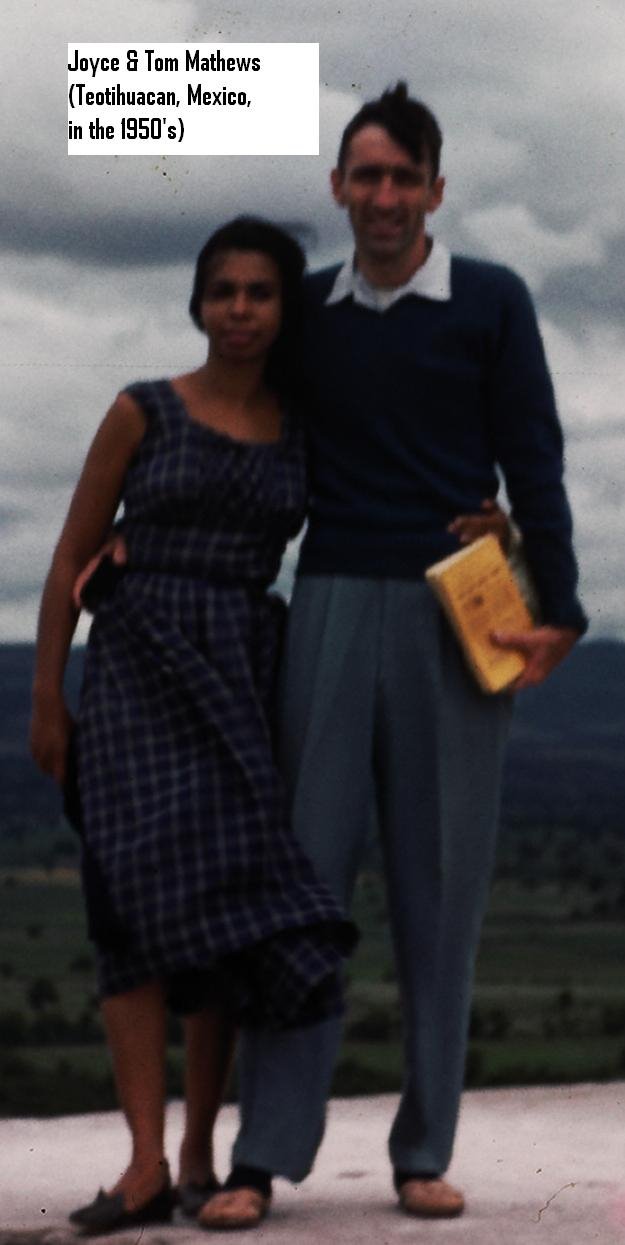
Tribute to my Father


Six years ago this day, my father passed away. While it is tempting to write something very personal about someone as central to one's life as my father was to mine, that is not my purpose here. Instead, I am presenting (and remembering) him in his role as a researcher. He was an historian, an educator and one of the leading Caribbeanists of the twentieth century. It should also be recalled that perhaps his most important work was about Puerto Rico. In this vein, I would like to reproduce here part of a report he submitted (before I was even born) on materials related to Puerto Rico held (at the time) by the U.S. Library of Congress:

General Survey of the material related to Puerto Rico held by the Library of Congress. Report submitted by Thomas G. Mathews, August 8, 1956. Published by Historia 6 (2) October 1956.

Following the suggestion of Dr. Howard Cline, Director of the Hispanic Foundation in the Library of Congress, The University of Puerto Rico granted me permission to spend four weeks surveying the material related to Puerto Rico in the Library of Congress. The Foundation requested that a report of this survey be drawn up in the hopes that it would offer a clear appraisal of the strength and weakness of the Library's material on Puerto Rico. This report could also serve as a guide to future action by the Library by indicating obvious gaps in the material or collections which needed rounding out. Obviously such a report would also enable the Library to better serve its readers and researchers in this particular field.

The University of Puerto Rico and scholars concerned with insular affairs should find the survey helpful in view of the fact that no previous effort has been made to describe in one study the Puerto Rican material found in the various divisions of the Library of Congress. In 1901 there was drawn up under the guidance of A.F.C. Criffin A List of Books on Porto Rico found in the Library of Congress. This, of course, is long out-dated and made no effort to explore the holdings of other divisions. It is hoped that the following survey will supply the reader with a ready guide to the material of the Library related to Puerto Rico, as well as an appraisal as to the quality of those holdings.

I wish to express my appreciation to Dr. Cline for the ready cooperation which he and his staff offered me during my four weeks. In all divisions of the Library I was willingly and readily served to my complete satisfaction, even when the requests were sometimes obviously out of the ordinary. I am indebted to Mr. Jorge Morales Yordan for the time he took to orient me as to the procedures, holdings, and classifications of the Law Library. If I have any criticisms to make in no way should they be interpreted as personal but rather in an effort to enable an under-staffed Library to serve more efficiently its readers.

Introduction

The material concerning Puerto Rico in the Library of Congress forms the largest single holding outside of the Archivo General de las Indias in Spain and the Library of the University of Puerto Rico. In the British Museum, the Bibliotheque Nationale de Paris, the New York Public Library and the National Archives [1] Puerto Rican material of importance can be located. For the most such holdings are limited in scope, in period covered, and by obvious national interests.

[1] The holdings of the National Archives is a residue of a collection of official papers relating to the Spanish Government in Puerto Rico which was shipped to the United States by a representative of the Library of Congress shortly after the American occupation. The body of material --some 200 boxes-- was returned to the island where it is reputed to have been partially destroyed by fire in 1926. The remaining material was sent from the Library of Congress to the National Archives where it can now be consulted.


The Library of Congress holdings relating to the period of discovery, conquest, and period of colonization can be located principally in the divisions of Rare Book and Manuscript. Copies of the classics of Latin American history in which there is always some mention of Puerto Rico--even though it be just in passing--can be found in the card catalog of the Rare Book Room. To the known accounts of Oviedo, Gomara,, Herrera, Las Casas, Laet,, etc. I would like to add a hitherto unknown visitor to Puerto Rico. "Captpitaine Gourges" writes of his brief visit to the shores of "Sainet Germaine de Porterique" in the latter quarter of the year 1569. [2] In the Manuscript Division the reproduction of material in European archives contains material on Puerto Rico, even though the reproductions were made with the purpose of securing material relative to North America. These holdings will be studied in detail below.

[2] "La Reprise de la Floride” in Histoire de la Floride franaise by
Paul Gaffarel, pp. 489-490 refer to Puerto Rico.

The holdings of the XVII and XVIII centuries should also be sought in the Rare Book and Manuscript Divisions. For works related to the lost half of the XVII century the general card catalog should be consulted in the general shelf area of Puerto Rico a copy of the 1788 Madrid edition of Fray Iigo Abbad y Lasierra’s Historia, geografica, civil.y politica de la Isla de San Juan Bautista de Puerto Rico (Imprenta de Don Antonia Espinosa) can be found. This of course should be placed in the Rare Book Collection. On this period, the Map Division also has material such as the four items of the Howe Collection which are described below.

The Library's holdings in the XIX century broaden out considerably, particularly toward the latter half of the century. Not only can more material be found on Puerto Rico but the quality is better. For example, the Manuscript Division can boast of not just mere reproductions of European archival holdings by an impressive collection of original material. The same is true of maps. Only the Divisions of Prints and Photographs and Music fail to show any holdings in the XIX century.

As would be expected, the material concerning the Spanish American War, as it is related to Puerto Rico, is plentiful. The collection of Col. Hoes, a U.S. Army chaplain, which has been integrated into the general holdings helps to explain this more complete coverage. A spot check on the more recent publications seems to indicate an adequate coverage as far as printed books are concerned. There may be a few exceptions to this which will be taken up later.

After this generous introduction, each division will be separately examined. It should be noted that I am not pausing to call attention to generally known material, but rather I prefer to single out that which can not be readily found. In some cases, such material may have little value in comparison to the more commonly known works but I prefer to run this risk since to do otherwise would be to reproduce what is found in the general card catalog under Puerto Rico (or Porto Rico since some divisions, like Rare Books, have failed to change their file to be in accord with the proper spelling) and thus give little justification for the report.

Manuscripts Division
Aside from the general collection of' the Library, this division has the largest amount of material on Puerto Rico and, in spite of the fact that a great number of the holdings are reproductions, the manuscript collection, while quite sparse as to the XIX century, is very valuable. A list with a brief description of the reproductions from the British Archives can be found in Appendix A; the French in Appendix B; and the Spanish in Appendix C.

Among the few reproductions of the French archives there is a hitherto unknown collection of outstanding interest to Puerto Rico. These manuscripts are found in the Museum d' Histoire Naturelle, having been sent there by one August Plee.

August Plee was, according to the Biographie Universalle (Tome Trente Troisime 1856) a botanist by profession. In 1819 at the age of thirty-two, he was sent by the royal government of France on a botanical excursion of the new world. He visited Canada and the United States collecting samples of plants and animals of all varieties. What he could not collect and ship back to France he carefully described and sketched.

From Norfolk, Virginia he journeyed south by boat into the Caribbean arriving at Puerto Rico the first month or two of 1822. He continued to collect specimens of fish, fowl, and sea life, such as mollusks. He also continued to sketch. As he traveled all over Puerto Rico from Mayaguez and Cabo Rojo, through Adjuntas and Ponce to Fajardo, and back to San Juan, he created beautiful sketches of the towns and countryside. His drawings which are listed in Appendix B are carefully done in perfect perspective and with such precision that one can recognize familiar buildings, such as churches, which are still standing today.

Mon. Plee in the brief introduction to his sketches explains that they will serve as a visual guide to the Journal of his explorations. Careful search in the catalog of the manuscripts of the Museum d'Histoire Naturelle [3] has failed to indicate that this Journal is among their collection. An effort should be made to locate it in the Museum. However, the chances are very good that the Journal failed to reach Europe just as its author failed.

[3] Mss.de la Bibliothque du Museum d' Histoire Naturelle por A. Boinet in Catalogue General des Mss des Bibliothques Publiques, Paris II (Librairee Plon 1914)

Leaving Puerto Rico in 1823 Plee passed through the Virgin Islands and the Leeward Islands stopping finally at Martinique. Here he contracted some tropical malady and died the 17th of August, 1825 at the age-:of thirty-eight. His collections of plant and fowl have found their way into proper care. His journal should be diligently sought. The reproductions of his sketches held by the Library are disappointing in that they are photocopies (white on black surface). My recommendation to the University of Puerto Rico is that they secure actual size black and white (if original are pencil sketches) photographs of this valuable collection of art works.

With the reproductions of the vast holdings of Spain, I utilized the unpublished work of two former employees of the Library of Congress. Dr. John Finan was working on a guide to the Spanish reproductions held by the Manuscript Division of the Library of Congress before he severed his relations with this division of the government. The state of the notes for this guide was such that with some effort Puerto Rican references could be singled out. This list of references is included in Appendix C.

Dr. Arturo Morales Carrion spent three months in 1946 in the position I temporarily hold, as consultant on Puerto Rican documents. Appended to this present report is a list of Spanish reproductions located by Mr. Morales pertaining to Puerto Rico. Copies of these reproductions were secured by the University of Puerto Rico for use by the History Department.

As can be seen by examining the list of Puerto Rican material drawn up from the work of Dr. Finan, the holdings are sparse and scattered over a three hundred year period. The reproductions held by the Library of Congress, and this is true of the French and British more so than the Spanish, pertain primarily to material concerned with North America. Therefore, while a diligent search would undoubtedly turn up more concerning Puerto Rico than has been revealed by Dr. Finan’s work, it is obvious that such time would be better spent in the Archivo General de las Indias of Spain. However, it goes without saying that Dr. Finan’s valuable work should be brought to completion and published so that researchers might be better served.

The manuscript material on Puerto Rico which is listed in the Handbook and can be found on the shelves in the general area assigned to Puerto Rico is so scattered and disorganized that it would be hopeless to do other than list the material with a brief description for each item. This is done in Appendix D. These documents are from the XIX century, although there are a few items-- as noted-- pertaining to the previous and the present century. In some cases (a lottery ticket or a canceled stamp) the value as historical material is negligible, in other cases-- the listing of foreigners or the memorandum on the telegraph system of the island-- the importance for historical research is obvious. On the whole, this material is very spotty and considered as a unit - which it is not - has little value.

The Puerto Rican Memorial Collection, donated to the Library by Miss Alice Gould, is the most valuable material of the Manuscript Division concerning Puerto Rico. Dr. Morales Carrion in his report discussed the manuscript part of this collection. His report is also appended to this study. (Appendix E) I have added to his work a more complete guide to the material found in the collection. The Library wisely adopted Dr. Morales' suggestions for the sorting and classification of these documents.

The Manuscript Division holds two very valuable microfilms, one of these is the original inventory typed under the direction of Sr. Cayetano Coll y Toste, of the 289 boxes of official documents shipped to the Library shortly after the United States occupation of Puerto Rico. This useful inventory of a vast quantity of material--much of which has been lost at this point--is in sufficient detail to be of service to historians interested in searching for material in the residue held by the National Archives. I urge the University to secure a copy of this microfilm for its own readers.

The other microfilm is not available to researchers until 1972. It is a copy of a diary of Eugenio Mara de Hostos. The original is in the possession of the sons of de Hostos but with their agreement and with the noted restrictions, the Library of Congress was able to secure a film of this priceless journal.

Material relative to Puerto Rico can also be found in the collections of private individuals donated to the Library of Congress. The manuscript Division holds some material donated by Chaplain Hoes of the Spanish American War. In Box 1 (Ac. 4159) can be found a collection of Correspondence with Congressional leaders concerning the War and federal relations with the newly acquired possessions. This material provides an excellent guide to congressional comments on Puerto Rico at the turn of the century.

Victor Clark, former Commissioner of Education of the island has also turned over material, which is indispensable to any study of the educational problems of the island. As Clark notes in his own description of the gift, many of the problems encountered when he was serving as Commissioner are still unsolved today.

The collection of two members of Congress also provide some scattered comments on Puerto Rico. One is a collection of letters of John Benson Foraker in which there are brief comments on Puerto Rican affairs by Nicholas M. Butler, Theodore Roosevelt and others, as well as the Senator himself. A list of some of these items is appended. The very extensive collection of John Sharp Williams, Senator from Mississippi contains very meager references to Puerto Rico. His material prior to 1914 in which should be found more material on Puerto Rico, has not been received by the Library. The material which is present contains comments on the island affairs and the general political scene but most of the correspondence refers to patronage. Since spot checks in the 192 boxes failed to turn up any extensive material on Puerto Rico, the limitation of time prevented a thorough search. There is in Appendix D a guide to the material which was located.

Two fairly recent donations to the Manuscript Division containing material relative to Puerto Rico complete the results of the search of this Division. Admiral William Leahy has turned over his diaries to the Library of Congress. Diary 5 covers the period from 1939 to 1940 during which Admiral Leahy served as Governor of Puerto Rico. The diary is quite disappointing in that it merely records activity with little or no personal comment interjected. A person very familiar with the administration of Leahy could sense some subtle references.

The other recent donation is the extensive (157.30 ft.) collection of private papers of Harold Ickes, Secretary of the Interior during the presidency of Franklin Roosevelt. This collection can be examined only with the permission of Mrs. Ickes and therefore cannot be fully described in this report. Mrs. Ickes was kind enough to grant me permission to examine the material.

Without violating any confidence, I feel free to state that while the Puerto Rico material is not as extensive as one would like, what is in the collection is of top historical value. For further information the reader is referred to my, forthcoming study on the New Deal and Puerto Rico.

The holdings of the Manuscript Division cover in time a four hundred year span: from the letter of Salazar, a reproduction from the Spanish Archives, to the late 1940's with the papers of Harold Ickes. This spreading out of course means very spotty coverage. However, the holdings are still of great value. Proof of this is found in the book by Dr. Morales Carrion, Puerto Rico and the Non-Hispanic Caribbean. Dr. Morales relied heavily on the reproductions of the European archives held by the Library of Congress. However, until Dr. Finan's work is completed, this material will not be fully utilized. The Gould material on Padre Rufo Fernndez is perhaps the only single collection of that pioneer educator who played such a key role in the training of the dominant figures of the latter half of the XIX century political scene. Any study of the Autonomista political party could not overlook the Gould material.

The Division's holdings of XX century material are also strong but could be made much stronger. The material on the Spanish American War could be added too. The Hoes Collection of manuscripts is disappointing. The veterans of this war and their descendents could be urged to turn material over to the Library. With the situation in Puerto Rico as it now is, the Library of Congress is in a much better position to secure this material, which is pertinent to one small branch of the Federal Administration, than any unit on the island.

Finally it should be admitted that a great deal of the odds and ends mentioned in the Appendix D is of little value unless there is wide knowledge of them by scholars. Even then I hardly know how one can make use of a lottery ticket but perhaps the fragmentary letter on the ambulance corp. could be utilized. Publication of this report and others--such as Dr. Finan's will serve this purpose.

Rare Books

The holdings of this Division related to Puerto Rico are quite unexpected and very limited. Unexpected is the word used because there are no examples of the very rare works on Puerto Rico such as the above--mentioned 1788 edition of Fray Inigo Abbad y Lasierra’s History, which is found on the general stacks. The two bound books of the Division relating solely to Puerto Rico are Las Clases Jornaleros de Puerto Rico by Salvador Brau and El Campesino Puertorriqueo by Francisco del Valle Atiles (this is an 1889 edition and not the 1887 edition noted in Pedreira).
Of course the Caribbean classics in which Puerto Rico is often mentioned are here. To those mentioned earlier in the general introduction the following authors could be added: Richard Blome, Johann Theodor de Bry, Pierre Franois Xavier de Charlevois, Thomas Coke, Thomas Jefferys, and Fathers Labat and DuTertre. In one book, De Nieuwe en Onbekende Weereld: of Beschryving van America en t' Zuid-Land ... door Arnoldus Montanus t' Amsterdam 1671, there are several references to Puerto Rico (pp. 167-170; 406-408) and an engraved plate of San Juan dated 1625. The material refers to the Dutch exploits in the Caribbean and specifically, on the pages cited, in Puerto Rico. The artist, however, has let his imagination run away with him and as a result the view of San Juan, while artistically pleasing, is a mixture of fact and fancy.

One other unexpected holding of this Division is a beautifully bound volume of periodical publications of the Nationalist Party. With the principal periodical—Pro Republica de Puerto Rico Ao I 1925 Nums. 1-10-- there are diverse flyers mixed in. Most of these are reprints of articles published in 1939-1940. A list of some of these articles and other broadsides found in the Rare Book Room is found in Appendix G.

Music Division
Little can be said about the meager holdings of this division. For an island of the Caribbean which is as productive in folk and popular music-to say nothing of its own danza-as is Puerto Rico, it is surprising and disappointing to see that the Library of Congress can refer to only a dozen or so items relating to insular music. Some attention should be directed both on the island and in the Library toward a remedy of this gap.

Newspapers
The collection of island newspapers is deceptive. There are many titles listed under Puerto Rico in the card catalog but closer examination reveals that few have any unbroken run. In fact, most of the papers are represented by only one number. The oldest Library of Congress paper is El Fenix of Ponce which runs from October 13, 1855 to December 23, 1858 with many issues missing. The picture fails to improve with the XX century. There are fewer newspapers but La Democracia is the only one which has an unbroken run up to the time of the Second World War. Concerted efforts should be made to complete the files of important dailies like El Mundo, El Imparcial, and La Correspondencia. With these three papers something could be done, but for El Pas, El Da, and others the gaps are too great to be filled. It is unfortunate that there is no major run of periodicals in the XIX century. The National Archives has an excellent series of a St. Thomas newspaper for most of the XIX century. Although printed in Danish, enough is in English to make it useful to American scholars. Finally, an effort should be made to secure copies of two recent English periodicals The Island Times and The World Journal, both published in San Juan and both important. (See Appendix H for a list of newspapers)

Map Division
This Division has a fine collection of originals and reproductions concerning Puerto Rico. The reproductions include copies of works in the Archivo General de las Indias and the Vatican Library in addition to copies of material found in various rare atlases. Four items purchased from the descendents of Lord Admiral Howe, pertaining to the XVIII century, are described in the Appendix I.

One of the prize finds of my month's work was the turning up of three very pleasing water-colored paintings of San Juan, said to be about 1824. Just why they are Maps is a little difficult to understand. The three views are A. from the east looking toward the west into the town and its fortifications; B. from the south looking north into the harbour area of San Juan; and C. from the west, slightly southwest, looking into the fortifications guarding the entrance to the harbour of San Juan. The colors are cool and pleasing with pastel shades and the work is excellently executed. The coincidence of the discovery of these three views after finding the sketches of August Plee makes me jump to a probably erroneous conclusion which is drawn more from wishful thinking than any factual comparison. The facts that the paintings are marked 1824 and Plee's visit was in 1823 lead one to speculate. While the reproductions of Plee's work are hard to compare with the original paintings, superficial similarity to an untrained eye makes me want to believe that August Plee is the anonymous painter of the three views.

Two other interesting items are 1) a plan of the hacienda Sta. Barbara of Bayamon dated 1824, and 2) a plan of a section of the harbour of San Juan with proposed expansion of dock facilities (early XIX century). Notes on these two plans can be found in the Appendix I.

The Map Division has a number of old atlases in which Puerto Rico can be located. These atlases with the appropriate plate are noted in Appendix I.

The holdings of this Division broaden out considerably around the turn of the century and the files are well stocked with recent maps of the Puerto Rican Reconstruction and Rehabilitation Administration and the present division of the insular government such as the Planning Board. The material in the Map Division is efficiently organized and easily gotten to.

Prints and Photographs
There is nothing in this division before the XIX century. However, there is abundant material after the turn of the century. There are about two hundred and fifty colored pictures for stereoptican viewers of the towns and countryside of the island about 1900. Victor Clark, Carl Grassl and others have contributed private collections of photographs to this division. These and other collections of views taken during the first decades of American rule are listed in Appendix J.

In the thirties two government agencies undertook two projects which have produced valuable holdings for the Library of Congress. The Survey of Historical American Buildings carried out about 1938 has contributed various views and plans of La Fortaleza, Porta Coeli, El Polvorin, El Morro and other historical structures around the island. The other project was carried out by the Farm Security Administration from December 1937 to January 1942. This produced a collection of some 1,500 enlarged pictures of all phases of Puerto Rican life, from cock fighting to labor troubles. The material in this division is also efficiently arranged and easily gotten to.

The Law Library
The material which I saw on Puerto Rico in the Law Library is not extensive nor is it complete. Futhermore, except for the items on the XX century, Puerto Rican material would be hard to locate. Material on Puerto Rico when it was a Spanish colony is rarely cataloged separately since Spain handled her colonies as a unit. Thus legal documents referring to Puerto Rico can be mixed in with material on Mexico or Argentina. Of course, there are some XIX century compilations of laws and royal orders pertaining to Puerto Rico. Too, decisions of Audiencias should not be hard to find. Some material can also be found under legal treatises and miscellaneous matters. All of this is cataloged under the Spanish colonies--Puerto Rico.

The holdings since the United States sovereignty are cataloged under Puerto Rico and are divided into the eight conventional categories of the Law Library. These with comments are listed in the Appendix. Strangely enough, under the seventh division is found Baldorioty de Castro’s signed copy of J. J. Acosta's edition of Fray Iigo Abbad y LaSierra’s Historia. Since this was a donation of Miss Gould to the Library, the Law Library, so it would appear, has questionable title to the work. There are a few other items which are misfiled in this section.

In the Law Library there has also been dumped some 150 pamphlets of the Gould collection. Most of these pertain to the previous century and are listed in the Appendix. They have been jammed into the dusty shelf, unarranged, uncataloged and almost forgotten. The explanation for the inexcusable neglect of this valuable collection is the lack of an adequate staff. This collection should be processed and the duplicates (of which there are quite a number) should be transferred to other libraries.


Thomas Mathews' book The Caribbean: History, Politics and Culture can be purchased at Merino & Sanchez Distributors, Inc., Ave. Las Palmas 1108 Pda. 18, P.O. Box 9024, San Juan, PR 00908-0024; Tels. 787-723-7827 & 787-723-0088; Fax 787-723-5850; email merinoysanchez@excite.com